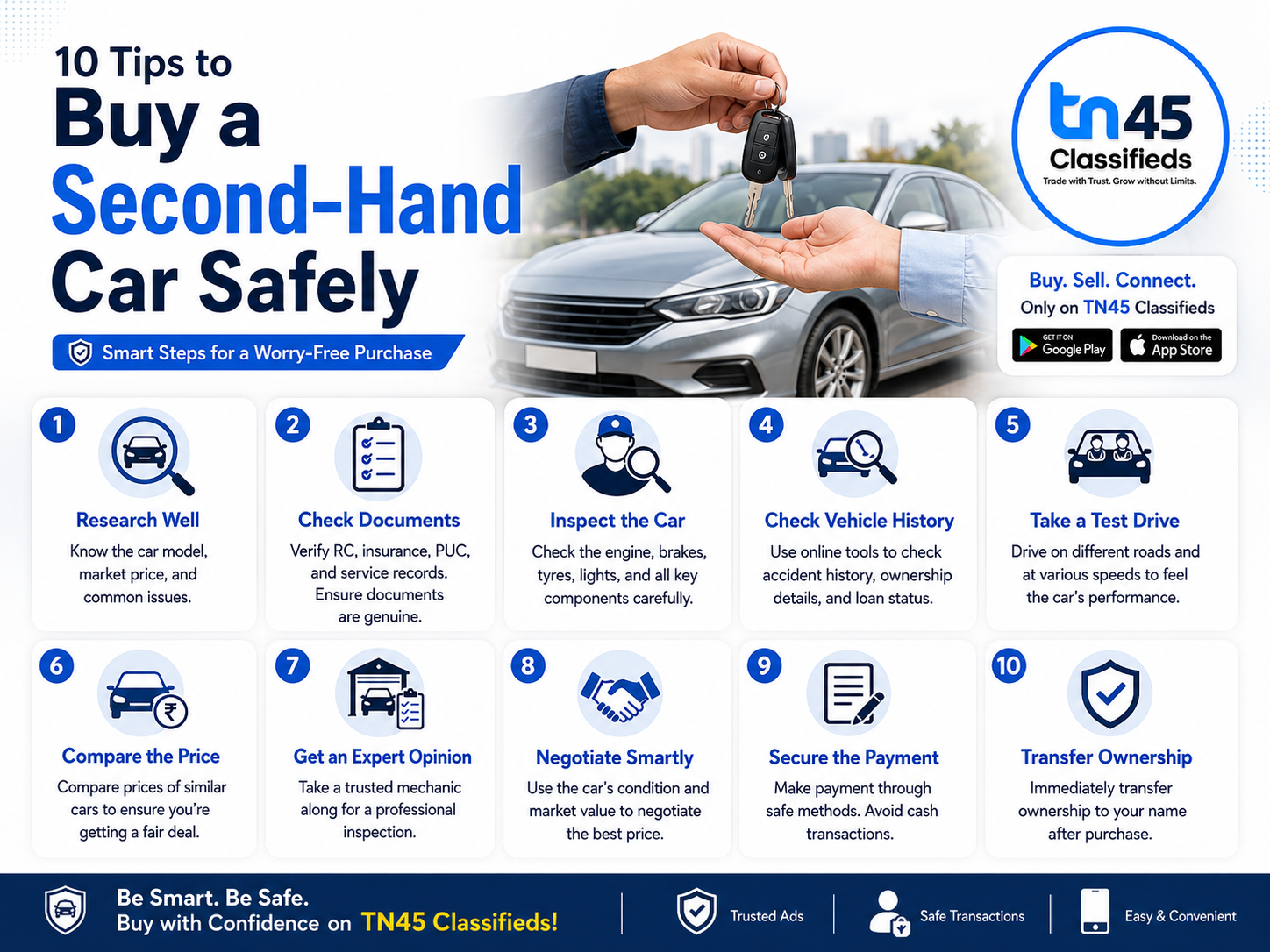
The Ultimate Guide to Buying & Selling Used Vehicles Safely in Tamil Nadu

The Ultimate Guide to Buying & Selling Used Vehicles Safely in Tamil Nadu
Buying or selling a pre-owned car or bike can be a smart financial decision. You can get a well-maintained vehicle at a much lower price than a new one—but only when the deal is properly verified.
In Tamil Nadu, a safe used-vehicle transaction should go beyond checking the asking price. Buyers should inspect the vehicle, verify ownership and documents, confirm finance status, check the transfer process, and remain alert to online classified scams. Sellers, meanwhile, should provide accurate information, maintain proper documentation, and complete ownership transfer promptly.
This complete guide from TN45 Classifieds explains how buyers and sellers can make safer, more confident deals.
Smart Tips. Safe Deals. Better Rides.
1. Before You Visit the Vehicle: Do Your Homework
A good deal begins before the test drive.
When you find a used bike or car through a classified listing, first compare the asking price with similar vehicles in the same area. Look at the vehicle's model year, kilometres driven, number of previous owners, condition, insurance status and major repairs.
Be cautious when a listing is priced dramatically below the normal market range. An unusually cheap vehicle may have hidden mechanical problems, incomplete documents, pending finance, ownership issues or a scammer behind the listing.
Ask the seller for:
-
Registration number
-
Make, model and variant
-
Manufacturing and registration year
-
Current odometer reading
-
Number of previous owners
-
Insurance status
-
Pollution Under Control (PUC) status
-
Service history, if available
-
Details of any outstanding loan or hypothecation
-
Reason for selling
Do not send a large advance simply because the seller claims that several other buyers are interested.
2. Pre-Owned Car & Bike Inspection Checklist
Never purchase a used vehicle based only on photographs.
A professional inspection is ideal, but even a basic physical examination can reveal warning signs.
Exterior Inspection
Check the body panels, paint finish, doors, bonnet, boot, mirrors, lights and windscreen.
Look for:
-
Different shades of paint between panels
-
Uneven panel gaps
-
Scratches or dents
-
Signs of repainting
-
Rust
-
Cracked lights or glass
-
Water or accident damage
-
Signs that airbags or body panels have previously been replaced
A vehicle that looks perfect in photos may have imperfections that only become visible in person.
Tyres, Wheels & Suspension
Inspect all tyres for uneven wear. Uneven wear can indicate alignment, suspension or steering problems.
Check:
-
Tyre condition and tread
-
Spare wheel, where applicable
-
Wheel damage
-
Suspension noises
-
Vehicle height and stance
-
Steering alignment
For a bike, inspect the fork, chain, sprockets, wheels and suspension carefully.
Engine & Mechanical Condition
Start the vehicle when the engine is cold whenever possible.
Pay attention to:
-
Unusual engine noise
-
Excessive vibration
-
Smoke from the exhaust
-
Oil leakage
-
Coolant leakage
-
Warning lights on the dashboard
-
Difficulty starting
-
Unusual smell
Do not rely only on the seller saying that "everything is perfect." A mechanic's inspection can help identify expensive problems before money changes hands.
Interior & Electrical Systems
For cars, test:
-
Air conditioning
-
Power windows
-
Central locking
-
Infotainment system
-
Reverse camera
-
Horn
-
Indicators
-
Headlights
-
Brake lights
-
Dashboard warning lights
-
Seat belts
For bikes, check the instrument cluster, electrical controls, indicators, horn, headlamp, brake lamp and starter system.
3. Always Take a Proper Test Drive
A test drive is one of the most important stages of buying a pre-owned vehicle.
Drive the vehicle in different conditions and listen for abnormal sounds.
Check:
-
Engine response
-
Gear shifting
-
Clutch performance
-
Braking
-
Steering
-
Suspension
-
Acceleration
-
Vibration
-
Wheel alignment
-
Reverse operation
-
Dashboard warning lights
For a car, test the vehicle on both smoother and uneven roads when safe to do so.
For a motorcycle or scooter, pay attention to braking, clutch operation, chain noise, suspension response and straight-line stability.
Never allow a rushed seller to pressure you into skipping the test drive.
4. Verify the RC and Ownership Details
The Registration Certificate, commonly called the RC, is one of the most important documents in a used-vehicle transaction.
Check whether the RC details match the vehicle and the person selling it.
Verify:
-
Registration number
-
Registered owner's name
-
Chassis number
-
Engine number
-
Vehicle make and model
-
Fuel type
-
Registration details
-
Vehicle class
-
Hypothecation/finance endorsement, if any
Compare the chassis and engine identifiers on the vehicle with the corresponding records and documents.
For a normal sale, the transfer process involves Form 29 and Form 30. Parivahan's official guidance also lists documents such as the RC, insurance certificate and pollution certificate as part of the ownership-transfer documentation.
Tamil Nadu's Transport and Road Safety Department similarly lists the RC, insurance certificate, valid emission certificate and other supporting documents for ownership transfer.
Why ownership transfer matters
Do not leave the vehicle in the seller's name after handing it over.
The Tamil Nadu Transport Department specifically warns that the previous owner can face legal problems if the vehicle is not transferred and the new user becomes involved in traffic violations, accidents or other offences.
Buyer: Make sure the ownership-transfer process is properly initiated and completed.
Seller: Do not assume that handing over the keys means the transaction is finished.
5. Understand NOC: When Is It Important?
The term NOC (No Objection Certificate) can refer to different situations, so buyers and sellers should understand which NOC is required.
NOC for Moving a Vehicle to Another Jurisdiction
Parivahan states that when an owner wants to remove or sell a vehicle outside the jurisdiction of the registering authority, an NOC can be required from the previous registering authority. The official process refers to Form 28.
Therefore, when buying a vehicle that is registered in another state or is being moved to another registration jurisdiction, verify the NOC and related transfer requirements before paying the full amount.
Financier NOC for a Loaned Vehicle
A different issue arises when the vehicle has been purchased through finance.
If the RC contains a hire-purchase, lease or hypothecation entry, confirm that the loan has actually been settled and that the necessary financier documentation is available. Tamil Nadu's official ownership-transfer guidance calls for an NOC from the financier where applicable.
Parivahan's guidance for termination of hypothecation refers to Form 35 and, where dues have been cleared, a due-clearance certificate from the financier.
Never buy a financed vehicle simply because the seller says, "The loan will be cleared later." Verify the status before completing the deal.
6. Check Insurance, PUC and Tax Status
The RC is not the only document that matters.
Check:
Insurance
Confirm that the insurance details are genuine and match the vehicle. Do not rely solely on a screenshot supplied by the seller.
PUC
Check that the pollution certificate is valid.
Tax & Other Dues
For applicable vehicles, verify whether taxes or other dues are outstanding. Tamil Nadu's ownership-transfer requirements include valid tax-paid status.
Service Records
Service invoices, workshop records and maintenance history can provide valuable evidence about how the vehicle was actually used and maintained.
7. Check for Accident, Flood or Major Repair History
A freshly polished vehicle can hide expensive repairs.
Look for:
-
Uneven paint texture
-
Overspray
-
Replaced body panels
-
Welding marks
-
Misaligned doors
-
Water stains
-
Electrical issues
-
Rust in unusual areas
-
Dashboard or airbag warning indicators
A vehicle that has suffered a major accident or flood may continue to create problems long after purchase.
For high-value transactions, consider getting an independent inspection from a qualified mechanic or inspection service.
8. Never Ignore the Seller's Identity
The person selling the vehicle should be able to establish that they are authorised to sell it.
Be particularly careful when:
-
The seller is not the registered owner
-
The seller says they are selling it "for a friend"
-
The owner is unavailable
-
The seller refuses to show original documents
-
The seller insists on payment to a third party
-
The seller gives inconsistent explanations about ownership
For an expensive purchase, verify the seller's identity and ensure the ownership and transaction documents are consistent.
9. Common Classified Vehicle Scams to Avoid
Online classifieds make buying and selling faster, but scammers can also exploit buyers and sellers.
Scam 1: Unrealistically Low Price
A scammer posts a premium car or bike at a price far below market value and creates urgency.
Warning sign: "Pay ₹5,000 now and I'll reserve it."
Safer approach: Inspect the vehicle and documents before paying an advance.
Scam 2: Fake Booking or Delivery Charge
The scammer claims that you must pay a "registration fee," "transport fee," "security deposit" or "gate pass fee" before viewing the vehicle.
Safer approach: Do not transfer money merely to arrange an inspection.
Scam 3: Fake Documents
Scammers may send edited RCs, insurance documents, ID cards or payment receipts.
Safer approach: Verify important information through official channels and compare physical vehicle details with the documentation.
Scam 4: Payment to a Different Person
The seller may say the vehicle belongs to one person but request payment into another person's bank account.
Safer approach: Resolve the ownership/payment mismatch before proceeding.
Scam 5: Pressure to Complete the Deal Immediately
"Another buyer is arriving in 10 minutes."
"Send the advance now."
"Tomorrow the price will increase."
Pressure is a common tactic used to prevent proper verification.
A genuine transaction should survive a reasonable verification process.
10. Safe Payment Practices
Never make a large payment solely on the basis of trust.
Before final payment:
-
Inspect the vehicle.
-
Verify the seller and ownership.
-
Check the RC and supporting documents.
-
Confirm finance/hypothecation status.
-
Verify insurance and PUC.
-
Agree on the final price in writing.
-
Prepare the necessary sale/transfer documentation.
-
Complete the ownership-transfer process.
-
Keep proof of payment and transaction records.
Avoid carrying large amounts of cash for a private vehicle deal.
Use traceable payment methods and retain transaction records.
11. Tips for Sellers: How to Get the Best Price
Selling safely is not just about finding a buyer. It is about presenting your vehicle professionally and honestly.
Clean Your Vehicle
A clean, well-presented vehicle creates a better first impression.
Wash the exterior, clean the interior and photograph the vehicle in daylight.
Provide Clear Details
Include:
-
Exact model and variant
-
Registration year
-
Approximate kilometres
-
Number of owners
-
Insurance status
-
PUC status
-
Service history
-
Known repairs
-
Accessories included
-
Expected price
-
Location
Honest descriptions attract serious buyers and reduce unnecessary calls.
Price It Correctly
Compare similar vehicles before deciding your asking price.
Avoid both extremes:
Too high: Buyers ignore the listing.
Too low: Buyers may suspect hidden problems.
A realistic, competitive price can help generate better-quality enquiries.
Respond Quickly
Serious buyers often contact multiple sellers.
A fast and professional response increases the chance of turning an enquiry into an inspection.
12. Use a Trusted Classified Platform
A well-structured classified listing makes it easier for genuine buyers to discover your vehicle.
With TN45 Classifieds, sellers can publish vehicle listings and reach buyers looking for cars, bikes, scooters, commercial vehicles and other products.
A strong listing should include accurate information, clear photographs and a realistic price.
List It. Reach More. Sell It Fast!
13. A Simple Buyer Safety Checklist
Before paying for a used car or bike, make sure you can answer YES to the following:
-
Have I personally inspected the vehicle?
-
Have I taken a proper test drive?
-
Does the RC match the vehicle and seller?
-
Have I checked the chassis and engine details?
-
Have I verified insurance?
-
Have I checked the PUC status?
-
Have I checked for outstanding finance or hypothecation?
-
Have I obtained the appropriate NOC where required?
-
Have I checked for accident or major repair history?
-
Have I confirmed the seller's identity?
-
Have I agreed on the final price and terms?
-
Have I avoided suspicious advance-payment requests?
-
Have I retained proof of payment?
-
Have I ensured the ownership transfer is properly completed?
14. A Simple Seller Safety Checklist
Sellers should also protect themselves:
-
Confirm the buyer's identity.
-
Do not hand over the vehicle based only on a payment screenshot.
-
Confirm that the money has actually reached your account.
-
Record the sale terms.
-
Complete the ownership-transfer process promptly.
-
Keep copies of relevant transaction documents.
-
Do not share unnecessary sensitive financial information.
-
Be cautious of fake buyers, fake payment links and impersonation attempts.
15. The Golden Rule for Used-Vehicle Deals
Whether you are buying or selling, remember one principle:
Verify first. Pay second. Transfer ownership properly.
A beautiful vehicle at a great price is not automatically a great deal.
A truly good deal is one where:
The vehicle is genuine + the seller is genuine + the documents are genuine + the payment is secure + the ownership transfer is completed.
Final Word
Buying or selling a used vehicle in Tamil Nadu does not have to be complicated—but it should never be rushed.
Take time to inspect the vehicle, verify the RC and supporting documents, understand NOC requirements, check finance status, avoid suspicious advance-payment requests and complete the ownership-transfer process correctly.
For sellers, accurate listings, clear photographs, fair pricing and fast communication can help attract genuine buyers.
For buyers, patience and verification can prevent expensive mistakes.
TN45 Classifieds — Trade Smarter, Connect Faster.
Buy • Sell • Connect
Find your next vehicle, list your current one, and make every deal with greater confidence.
Important: Vehicle-transfer requirements can vary depending on the vehicle, registration jurisdiction, finance status and transaction circumstances. Verify the current requirements with the relevant RTO/STA and official Parivahan services before completing a transaction.
Is this blog helpful?
1
0
Related Articles
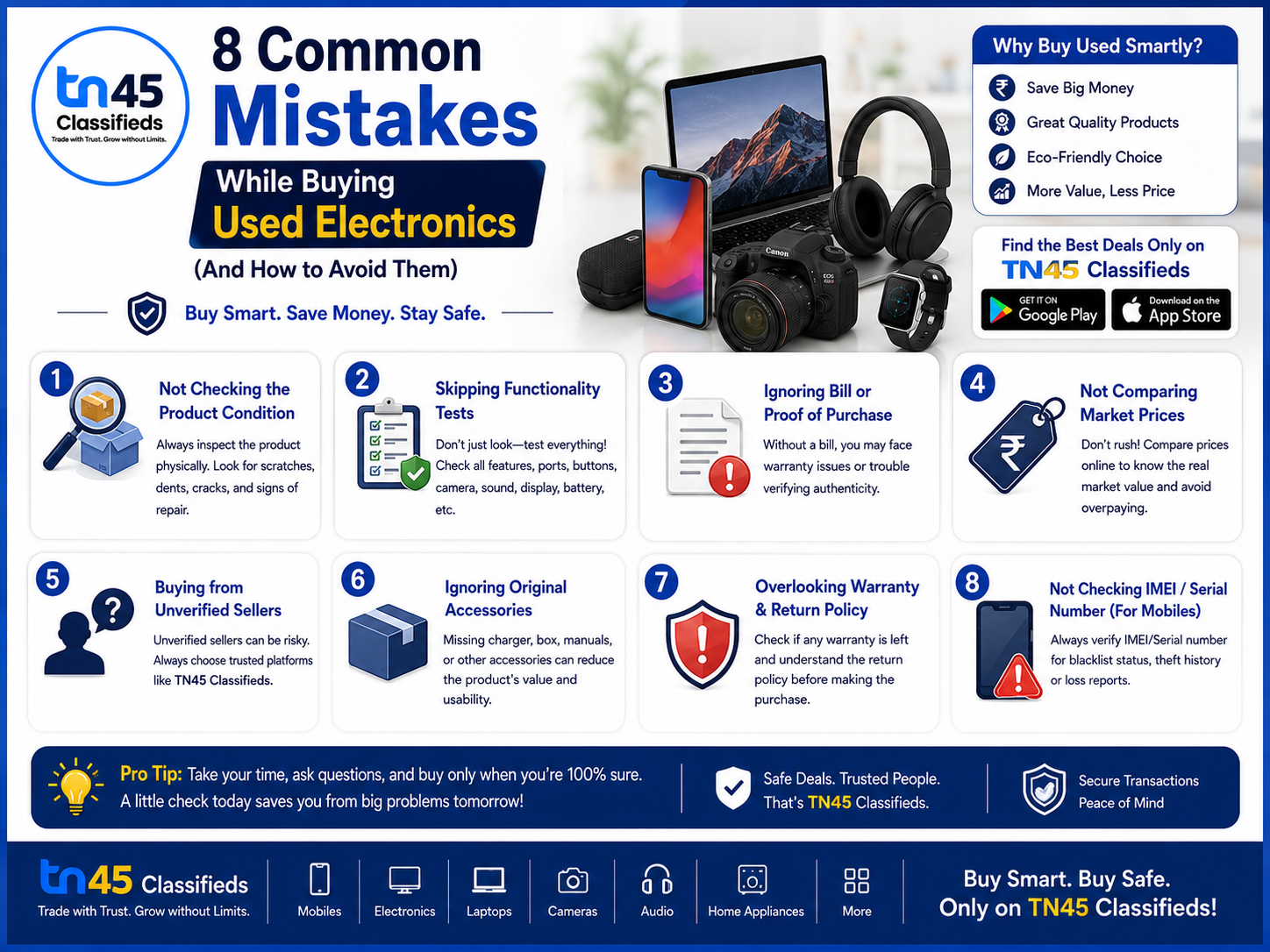
8 Common Mistakes While Buying Used Electronics (And How to Avoid Them)
Buying second-hand electronics—whether it is a flagship smartphone, a high-performance laptop, a tablet, or a DSLR camera—is a fantastic way to upgrade your tech without emptying your wallet. You can often score premium gadgets for 30% to 50% off their retail price. <p style="text-align: justify;" data-path-to-node="9
Read Blog